
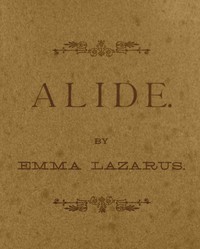
Alide: an episode of Goethe's life. by Emma Lazarus
Let's be honest, most of us know Johann Wolfgang von Goethe as a monumental figure—the Shakespeare of German literature. Emma Lazarus's Alide: an episode of Goethe's life does something much more intimate. It shifts the spotlight.
The Story
The book focuses on Alide (based on the real Friederike Brion), a pastor's daughter living in a small German village. Her peaceful world is turned upside down when a vibrant, ambitious young law student named Goethe arrives. They fall into a deep, poetic love. Through Alide's eyes, we see Goethe's charm and brilliance, but also his restlessness. The central question isn't if he'll leave, but how Alide will endure it. The story follows the aftermath of his departure, exploring how she rebuilds a life from the fragments of a love that was, for him, just one chapter, but for her, her entire heart.
Why You Should Read It
Lazarus, writing in the 1870s, clearly identifies with Alide's position. She wasn't just writing historical fiction; she was asking a timeless question about art and sacrifice. Whose story gets told? This book gives a voice to the woman history often reduces to a footnote. Lazarus's prose is clear and poignant, full of careful observations about nature and emotion. You feel the stifling quiet of the village after Goethe's dazzling energy departs. You understand Alide's conflict between her own sharp mind and the limited future society has mapped out for her. It makes you rethink the whole idea of a 'muse'—it's not a passive role, but often one of profound personal cost.
Final Verdict
This is a perfect pick for readers who love literary history but want the human story behind the famous names. It's for anyone who's ever enjoyed a novel about complex relationships or the inner lives of women in historical settings. Because it's a novella, it's not a huge commitment, but its emotional weight is significant. You'll come away thinking less about Goethe the icon, and more about Alide the person—and that's exactly what Lazarus intended.
This title is part of the public domain archive. You are welcome to share this with anyone.
David Perez
3 months agoSurprisingly enough, it creates a vivid world that you simply do not want to leave. Definitely a 5-star read.
Patricia Gonzalez
2 months agoAmazing book.
David Thompson
1 year agoSimply put, the content flows smoothly from one chapter to the next. I learned so much from this.
Charles Smith
7 months agoThis is one of those stories where the flow of the text seems very fluid. I learned so much from this.





Ashley Harris
1 year agoAmazing book.